What Providers Need in a Home Respiratory Partner After Discharge
What physicians, case managers, and discharge planners should look for in a home respiratory partner, from RT-led care to pre-discharge setup, to protect continuity of care and reduce readmissions.
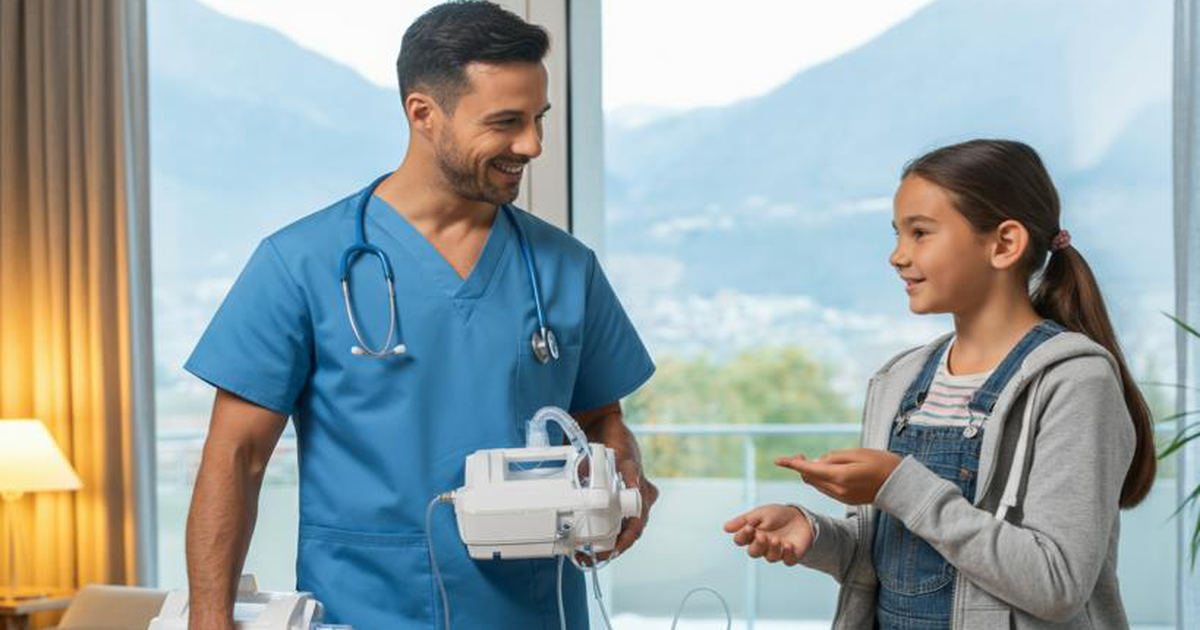
By the time a discharge order is written for a patient who depends on a ventilator, supplemental oxygen, or daily airway clearance, the most demanding part of the transition is just beginning. The hospital stay is structured and continuously supervised. Home is neither. For physicians, case managers, and discharge planners, the question is rarely whether a patient can go home. Instead, it's whether the partner receiving that patient will hold the same standard of care once the hospital doors close behind them.
Choosing a home respiratory provider is a clinical decision, not a logistics one. The right partner becomes an extension of your care team; the wrong one becomes a source of callbacks, gaps, and avoidable readmissions. Here is what to look for in a partner you can hand a complex patient to with confidence.
An experienced respiratory therapist who owns the clinical relationship
The first thing to confirm is who manages the patient after discharge. Almost anyone can drop off equipment. But complex respiratory care requires more. Caring for medically complex patients requires a partner whose model is led by credentialed respiratory therapists (RTs), who are accountable for the clinical plan – not one where a therapist is reachable only as an exception.
This is the foundation of Unicare's provider model: respiratory therapists coordinate directly with physicians, case managers, and discharge planners on equipment selection, setup, and ongoing clinical oversight to keep high-acuity patients stable at home. When an RT owns the relationship from referral forward, your team has a clinical peer to call, not a dispatcher, not a delivery driver.
Set-up that happens before discharge, not after
A safe transition is built before the patient leaves the building. That means pre-discharge planning, a home assessment, equipment tested in advance, and caregivers trained while clinical support is still close at hand. A partner who begins working only after discharge has already introduced a gap.
This matters well beyond convenience. Poorly managed care transitions are a leading driver of preventable readmissions, and since 2012, Medicare has reduced payments to hospitals with higher-than-expected 30-day readmission rates. The Agency for Healthcare Research and Quality has documented how structured discharge and transition processes measurably lower those rates. A home respiratory partner that trains the family, verifies the equipment, and confirms the plan before discharge is doing the work that keeps patients home and out of the emergency department.
Communication that lightens your team's workload
Discharge planning is hard enough without chasing a vendor for status updates. A strong partner verifies insurance eligibility up front, communicates proactively with referral sources, and provides clear updates at each step, so the work of coordination doesn't fall back on your case managers.
The goal is to reduce the administrative burden on clinical teams, not add to it. When eligibility is confirmed quickly and the referral source is kept informed, the handoff feels less like a transfer of risk and more like a continuation of care.
One partner across the full range of home needs
Complex patients rarely need just one thing. A patient leaving on a ventilator may also need a hospital bed, suction supplies, enteral nutrition, and a consistent monthly resupply. Every additional vendor is another phone number, another delivery window, and another opportunity for something to fall through.
A single source for respiratory care, home medical equipment, supplies, and nutrition removes those seams. Unicare coordinates all of it under one team: one referral and one point of contact, which is part of why families describe the relationship in terms that go beyond equipment. (Their words are worth reading on the Testimonials page.)
Support that continues long after the setup
Delivery is the beginning of care, not the end of it. The patients you discharge today will need compliance monitoring, equipment troubleshooting, and a clinician available when something changes at 2 a.m. Ask what ongoing support actually looks like: Is there 24/7 on-call respiratory coverage? Are there proactive check-ins, or only reactive ones?
This is especially true for home ventilation, where confidence and education matter as much as the device itself. Unicare's guide on home ventilation myths and realities and its broader library of resources reflect a simple principle from the company's values: experience matters as much as equipment.
The bottom line for referral partners
The strongest home respiratory partners share a profile: respiratory-therapist-led, organized before discharge rather than after, communicative without prompting, comprehensive across the patient's full set of needs, and present for the long term. That combination is what protects continuity of care and your patients once they're home.
Unicare Health has delivered complex care at home since 1988, supporting more than 7,000 patients with ventilator dependence, neuromuscular disease, ALS, and chronic lung conditions across California. If you're coordinating a discharge and want a partner who will uphold your standard of care, connect with our provider team. We are built to respond quickly and put the right respiratory support in place before the patient goes home.

Questions? We're here to help.
Contact your Unicare Health pediatric respiratory therapist or call 800.400.6333 for support, supply orders, or guidance on your child's at-home respiratory care.